
Cost segregation has emerged as one of the most powerful tax planning strategies for real estate owners and investors, especially in the wake of sweeping legislative changes in 2025. By accelerating depreciation deductions and optimizing capital recovery timing, cost segregation can unlock significant tax savings and improve cash flow. This article explains how cost segregation works, how it helps reduce taxes, and why it is more valuable than ever under the current tax environment.
What Is Cost Segregation?
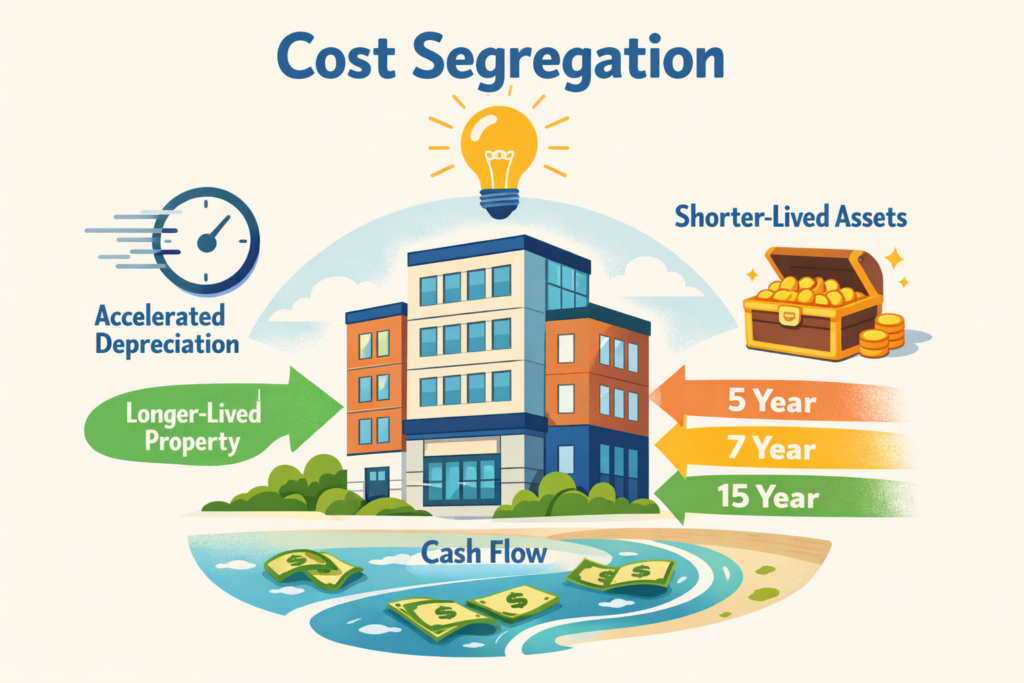
Cost segregation is a tax engineering strategy that reallocates portions of a building’s cost basis from long-lived real property (typically depreciated over 27.5 or 39 years) into shorter-lived categories eligible for accelerated depreciation.
Under the federal tax code, buildings are depreciated under the Modified Accelerated Cost Recovery System (MACRS). Most structural components, like walls, roofs, and plumbing are subject to long life-span classes. However, many internal assets (e.g., fixtures, equipment, certain finishes, land improvements) have shorter economic lives that qualify for accelerated depreciation.
Key benefits:
- Moves costs from 27.5- or 39-year classes into 5, 7, or 15-year categories
- Generates earlier depreciation deductions
- Reduces taxable income in early years
- Improves cash flow and increases reinvestment capital
How Cost Segregation Generates Tax Savings
Accelerating Depreciation and Tax Deferral
Rather than depreciating an entire property over decades, cost segregation allows taxpayers to:
- Reclassify eligible components (e.g., carpeting, specialized lighting, site improvements)
- Use accelerated depreciation methods (e.g., 200% declining balance)
- Front-load depreciation deductions into the early years of ownership
This accelerated write-off defers taxes, which enhances the net present value of deductions, meaning the tax savings today are worth more than the same deduction spread over decades.
100% Bonus Depreciation (Permanently Restored)
The One Big Beautiful Bill Act (OBBBA) of 2025 significantly strengthened incentives for cost segregation:
- Restored 100% bonus depreciation permanently for qualifying assets placed in service after January 19, 2025
- Allows full expensing of eligible property in the year it is placed in service
- Applies to property with a recovery period of 5, 7, or 15 years
For example, if 30% of a $2 million purchase price is reallocatable to shorter-lived assets, a full first-year deduction of $600,000 could be possible , dramatically increasing cash flow and tax savings in year one compared to traditional depreciation.
For a deeper discussion on how bonus depreciation works and which assets qualify, see our detailed overview on bonus depreciation.
Short-Term Rentals: A Unique Planning Opportunity
Cost segregation is especially powerful when paired with short-term rental (STR) properties. Under IRC Section 469, most rental activities are classified as passive, meaning losses can only offset passive income. However, an important exception exists for properties with an average guest stay of seven days or less.
The 7-Day Rule and Material Participation
When an STR meets the 7-day rule, it is treated as a trade or business rather than a rental activity. If the owner materially participates, depreciation losses may be classified as non-passive and can offset active income such as W-2 wages or professional earnings.
The most relevant material participation tests for STR owners include:
- 500-Hour Test: The taxpayer participates for more than 500 hours during the year
- Substantially All Test: The taxpayer performs substantially all of the work
- 100-Hour Test: The taxpayer participates for more than 100 hours and more than any other individual
When cost segregation is applied to an STR and material participation is met, 100% bonus depreciation on 5-, 7-, and 15-year assets can generate substantial active losses. This loss can directly offset W-2 income, clinical salaries, or other business earnings, often resulting in tax savings that exceed the initial down payment on the property.
Look-Back Studies (Form 3115): Capturing Missed Depreciation
Cost segregation isn’t only for new purchases. Owners of properties acquired in prior years can file Form 3115 to change accounting methods and claim missed depreciation through a Section 481(a) adjustment. This adjustment typically results in a one-time deduction equal to the cumulative difference between depreciation taken and depreciation that could have been taken.
Importantly:
- No amended returns are usually required
- Bonus depreciation is applied based on the original placed-in-service date
Disposition Planning and Depreciation Recapture
While the benefits of cost segregation are front-loaded, a well-structured tax plan must also account for the back-end of the investment lifecycle: property disposition. When a property is sold, the IRS requires “depreciation recapture,” where the gain is taxed at different rates based on the asset classification.
Section 1245 vs. Section 1250 Recapture
Gains attributable to Section 1245 personal property are recaptured at ordinary income tax rates, which can reach 37%. In contrast, gains on Section 1250 real property are subject to a maximum “unrecaptured section 1250 gain” rate of 25%.
The “1245X” strategy involves a valuation study at the time of sale to determine the actual fair market value of the segregated components. In many cases, assets like carpeting or decorative lighting have depreciated physically and economically, often having zero value after five or ten years. By allocating the sale price primarily to the structural building (Section 1250) and land, rather than the “worn out” personal property (Section 1245), the seller can significantly reduce their ordinary income recapture tax.
Conclusion: Cost Segregation as a Cornerstone of Tax Strategy
Cost segregation is no longer an optional add-on, it is a strategic necessity in the modern tax landscape. With the permanent restoration of 100% bonus depreciation, expanded incentives like QPP, and technical improvements to interest deduction rules, cost segregation delivers unmatched tax savings and cash-flow advantages.
Disclaimer and Important Information
This content is not personalized tax advice. If you’re interested in these topics, we encourage you to reach out to us or a qualified tax professional for advice tailored to your specific situation. Nothing in this content restricts anyone from disclosing tax treatment or structure. If you need personalized tax advice, consult us or another tax professional. This information is general and subject to change; it’s not accounting, legal, or tax advice. It may not apply to your unique circumstances and requires considering additional factors. Please contact us or a tax professional before taking any action based on this information. Tax laws and other factors may change, and we are not obligated to update you on these changes